-1.png?width=50&name=Ted%20(1)-1.png)
-1.png)
The Insurance Battleground Has Changed
The insurance industry is transforming faster than ever. Customer expectations are rising, digital-first challengers are expanding, and regulatory demands continue to evolve. Emerging technologies—AI, analytics, IoT, automation—are redefining what 'good' looks like in insurance operations. This is not news to any of us; it’s just the facts.
Major consulting firms such as Accenture, EY, Deloitte, and McKinsey consistently highlight the same trend: insurers who wish to stay competitive must shift from building capabilities internally to leveraging dynamic, connected ecosystems. The winners will be those with the most adaptive combinations of technology, data, and partners.
"In my conversations with CIOs and Heads of Innovation and Digital Transformation, the conversation has shifted over the last years. Before, the question was “Can we build this in-house?” Today, with the velocity of tech evolution, the question is “Who is the best partner to plug into our core? The answer is clear: trying to own every part of the tech stack is no longer a badge of honor—it's a liability." — Ted Cederlund, Head of Strategic Partnership, Seamless Insure.
Why Ecosystems Have Become a Strategic Imperative
The complexity of the insurance value chain has outgrown internal capabilities Traditional in-house system development is no longer sustainable—platforms age quickly, integrations become fragile, and IT maintenance consumes resources that could drive customer value instead.
Accenture’s report “Insurers: Go All-In on Ecosystems” found that 84% of executives consider ecosystems strategically important, yet fewer than 5% are ready to lead one. This gap highlights how crucial ecosystem orchestration has become.
McKinsey defines ecosystems as interconnected services that fulfill customer needs in unified experiences. To achieve this, the "closed garden" approach must end.
Speed is the new competitive currency Ecosystems allow insurers to implement and scale capabilities in weeks instead of years. EY notes that innovation and modernization pressures are accelerating, making ecosystem partnerships essential.
Customer and distribution expectations require orchestration Modern experiences—real-time risk scoring, instant claims, frictionless onboarding, embedded distribution—require capabilities no single insurer can build alone.

What a Modern Insurance Ecosystem Looks Like
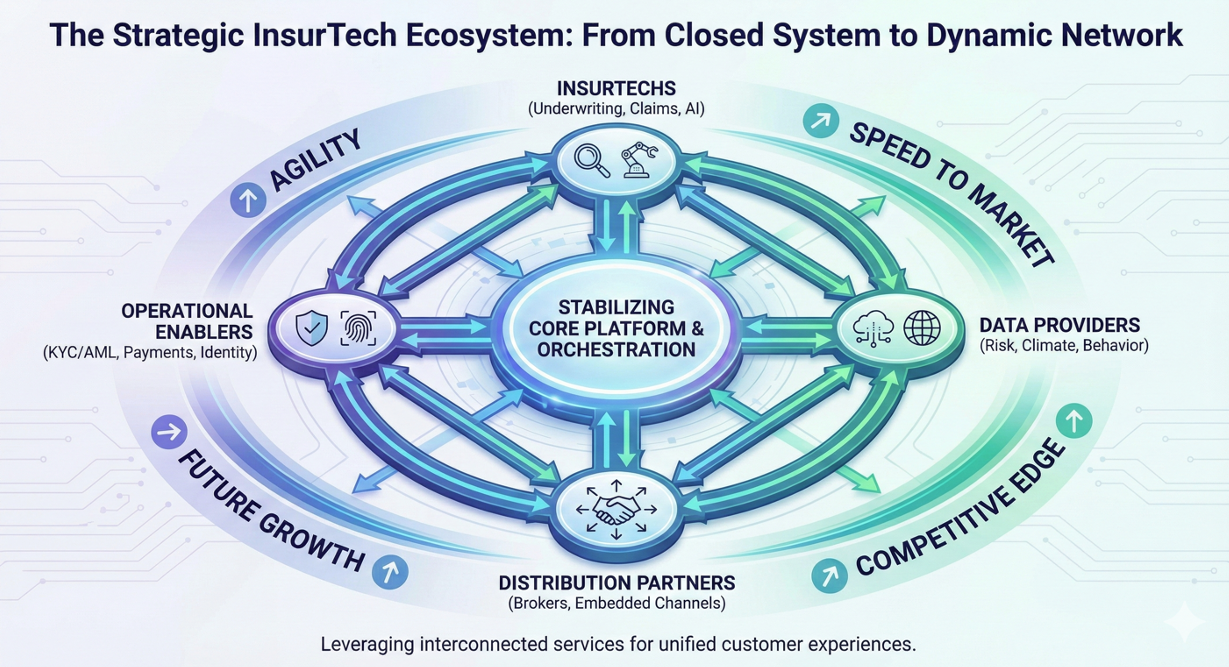
A strong ecosystem is not just a vendor list; it is a curated network of InsurTechs, data providers, operational vendors, and distribution partners—all interoperable with the insurer’s core platform.
Key components include:
- The Foundation: Core policy, billing, and claims platform.
- The Specialists: Underwriting and claims InsurTechs.
- The Intelligence: Data providers for property, health, climate, and behavior.
- The Reach: Distribution partners (brokers, embedded channels).
- The Enablers: Operational tools (KYC/AML, payments, identity).
- The Rules: Integration and API governance frameworks.
Governance: The overlooked success factor Ecosystem success depends on standards, security models, provider evaluation, and architectural governance. EY recommends insurers modernize core systems and partner with forward-looking InsurTechs as part of ecosystem strategies.
The Role of the Orchestrator: Stabilizing the Core
The need for a stabilizing core To succeed, insurers need a stabilizing core—
a flexible, API-driven foundation designed for rapid integration. Without this, an ecosystem is just chaos. A true orchestration platform ensures data consistency, reduces integration effort, and enables scalable operations across policy, claims, billing, and product configuration. At Seamless Insure, we view this stability as the prerequisite for any innovation.
Curating the ecosystem: Quality over quantity The Insurtech market is crowded and difficult to assess. Insurers often face "integration fatigue" when trying to vet hundreds of potential providers. A strategic platform partner reduces this complexity by:
- Vetting partners for security, performance, and insurance relevance.
- Maintaining a curated network of trusted providers, so insurers don't have to start from scratch.
- Providing integration templates to standardize data flow.
- Ensuring architectural coherence as new partners are added.
Proactive ecosystem development The market doesn't wait for roadmap planning. An effective orchestrator actively identifies high-value Insurtechs, tests integrations, and prepares reusable blueprints. This allows insurers to adopt capabilities—like AI damage recognition or parametric triggers—before market pressure forces them to.
"A common trap we see insurers fall into is treating API integrations as 'one-off' projects. They build a custom bridge to a data provider, then another to a payment gateway. Six months later, they have a web of connections that easily break whenever a partner updates their code. The value of an orchestrator isn't just connecting A to B; it's about creating a standard language so you can swap partners in and out without tearing down the house." — Ted Cederlund, Head of Strategic Partnership, Seamless Insure.
Helping Insurers Choose the Right Providers
Technology selection impacts operating ratios, customer satisfaction, and resilience. As an ecosystem enabler, Seamless Insure supports insurers through structured evaluation and guided decision-making.
Key evaluation criteria include:
- Business impact: Does this solve a verified user problem?
- Integration complexity: Is it a heavy lift or a plug-and-play?
- Scalability and uptime: Can it handle peak volumes?
- Regulatory fit: Does it meet local compliance standards?
- Cost and ROI: Is the value clear?
- Documentation and support maturity: Will they be there when things break?
The Impact of Pre-Integration With a pre-integrated ecosystem approach, deployment timelines shrink dramatically. We have seen projects move from 12–18 months to 3–6 months, simply by leveraging existing "blueprints" rather than building custom code.
-1.png?width=603&height=735&name=Seamless%20attains%20SOC2%20Compliance%20(6)-1.png)
Get in touch with us:
Conclusion: The Insurer of the Future Is Not a Closed System
Research from Accenture, EY, Deloitte, and McKinsey underscores the same message: the future belongs to ecosystem-enabled insurers.
Modern insurers must be:
- Flexible
- Connected
- Insight-driven
- Well-governed
- Supported by platforms built for orchestration
Seamless Insure’s mission is to make these ecosystems not only possible but transformative. We believe the ecosystem should consist of true partners, not just vendors. The question for insurers is no longer if they should build an ecosystem, but how fast they can stabilize their core to support one.
Because the future of insurance is not built alone — it’s built together.
References
- Accenture – Insurers: Go All-In on Ecosystems (2019)
- McKinsey – Ecosystems and Platforms Report
- EY – 2025 Global Insurance Outlook
- EY – Ecosystems in Insurance: What Winners Do Differently
- Deloitte – 2026 Global Insurance Outlook
- Deloitte – Digital Ecosystem Connectivity
Related posts

Insights from the Reinventing Finance Podcast with Nelius Strydom, CEO of Seamless Insure

The question is no longer *can we build it?* Almost anything is buildable now. The real question...

From 19 June 2026, traders concluding distance contracts with EU consumers through online...