

Insights from the Reinventing Finance Podcast with Nelius Strydom, CEO of Seamless Insure
Most insurers are optimising for a world that no longer exists.
Better products. Faster underwriting. Slicker distribution. All valuable — but none of it is a moat anymore.
AI is eroding product advantages that took years to build. Technology is accessible. A differentiator that took five years to develop can be replicated in five months. The old playbook is running out of road.
So the real question isn't how to build a better product. It's who actually captures value when the product stops being the point.
The pool shift nobody is talking about
The first thing to understand is that the unit of competition has changed.
Insurers used to compete for individual customers. The new game is capturing entire pools — parking garages, camper van associations, events companies, telcos — and owning the relationship at the point of need.
This isn't just a new distribution trick. It rewires the economics of the whole value chain. When you own the pool, you don't compete on price. You design the product, structure the fees, and keep margin well beyond the traditional commission. That's what Nelius Strydom, CEO of Seamless Insure, calls "selling for value" rather than "selling for commission."
The implications are uncomfortable for traditional carriers: if the distributor owns the pool, constructs the product, and keeps most of the margin — what exactly is the insurer for?
Are carriers becoming regulated balance sheets?
Maybe this sounds like a harsh question. But it's the right one.
For personal lines and plain vanilla commercial products, the carrier's role is shrinking. Technical premium, risk capacity, regulatory wrapper. Everything else — product design, data enrichment, customer experience, distribution — is moving outside.
For complex risks, that's not true. Marine, captives, specialist lines still need deep carrier expertise. But for the growing middle ground of embedded and scheme-based products, the value is sitting elsewhere. And the carriers who aren't honest about that are going to be surprised by where their margin goes.
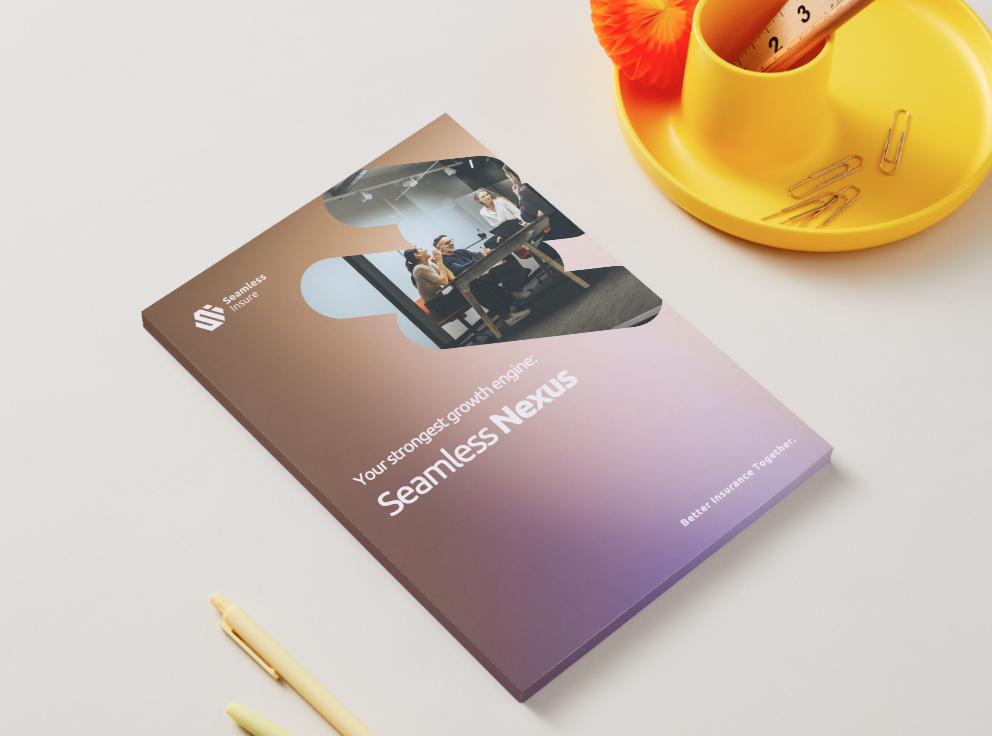
Scale distribution, empower partners and grow faster
The question for every carrier and partner is no longer whether to modernise distribution infrastructure — it is how quickly. Seamless Nexus is built for organisations that want to move from being reactive participants to becoming the platform others choose to build on. Speed, scale, control, and efficiency — in one ecosystem.
The infrastructure moat — and what it actually means
Here's where the conversation gets interesting.
The firms winning right now aren't winning on product. They're winning on infrastructure — but not in the way most people mean it.
It's not APIs. It's not cloud hosting. Everyone has that. The real infrastructure is the ability to orchestrate an ecosystem of data providers, pricing engines, underwriting tools, and distribution channels — and reconfigure that ecosystem faster than anyone else can copy it.
MySafety, a Swedish client of Seamless, is a good example. Their competitive advantage isn't a product. It's a front end and middle layer that connects dozens of distribution pools and routes them back into a single platform. Unless you've built that connectivity, you can't replicate it. No commission structure replicates it. No relationship does either. It only works because of the technology — and the intelligence baked into it.
That's what a moat looks like now. Not a product. A continuously reconfiguring capability.
If a new pricing engine comes on the market, I want to be able to connect to that within two weeks. I don't want to wait two years." Traditional insurers, locked into core systems they replace every 15–20 years, simply can't move at that speed.
This is where smaller, more agile players — particularly tier two and three insurers and MGAs — have a real opportunity. They can move quickly, plug into new ecosystems, and punch well above their weight. The infrastructure is, as Nelius puts it, "levelling the playing field."
Why embedded programs keep failing
The embedded insurance graveyard is full of good ideas that didn't survive contact with reality.
Two failure modes keep recurring.
- Underwriting losses — products priced too cheaply to be commercially viable — chasing volume until the underwriting losses catch up.
- Forcing products down the wrong channel — forcing products into the wrong context. Motor insurance on a food delivery app doesn't work. The context has to make sense.The context simply doesn't fit.
The programmes that work now look different. The distributor has invested in the infrastructure. The product has been genuinely designed, not just repackaged. Everyone at the table has something to lose if it doesn't perform.
I'm optimistic that the next generation of distribution platforms will sidestep both problems. Better data means better pricing. And providers who build their own insurance businesses — rather than just reselling for commission — have real financial skin in the game. "I cannot afford to let it fail," is the mindset shift we see in the market, and it changes everything about how the programme runs.
Commoditisation vs. Maturation
One tension the conversation keeps returning to is whether embedded insurance is becoming a commodity — and whether that's bad for insurers.
Nelius sees it differently. Products like handset insurance or standard travel cover may already be commodities. But the market is maturing fast. More complex, personalised products are being sold through embedded and scheme-based channels — products that require real underwriting expertise, external data enrichment, and thoughtful product design.
"Embedded insurance is almost becoming old news," he says. "What we're seeing now is much more sophisticated distribution platforms." The opportunity isn't just in selling a simple add-on. It's in building the capability to run 50 products across 10 countries, profitably, with consistent operations — and that's where technology becomes genuinely decisive.
AI, Agentic Coding, and the R&D Trade-off
Engineering costs are falling. Agentic coding is real. In every industry development costs have dropped thanks to AI and agentic coding.
But here's the trade-off nobody talks about: R&D budgets are ballooning.
The pace of change is now so fast that you can't wait six months to evaluate a new capability. If something hits the market, you need to know within weeks whether your competitors will use it and what you'll do about it. Senior attention is being reallocated from building to continuously scanning, testing, and deciding.
AI is also proving valuable somewhere less obvious: at the conceptualisation stage, before a single line of code is written. Getting people across product, legal, marketing, jurisdiction, and technology aligned on what's actually being built — that's where most programmes go wrong. Not in the execution. In the planning, when promises are made that the technology can't keep.
The firms that get this right are the ones who put commercial and technical intelligence in the same room, at the earliest stage of design. That sounds obvious. It almost never happens.
Who wins: Carrier or MGA? —It's not for the reason you think
Given all of this, which type of player — insurer, MGA, broker, TPA, technology vendor, platform distributor — is best positioned to win?
Ask which type of player is best positioned to win, and the answer varies by market. In the Nordics, MGAs are moving fastest. In the Middle East, traditional embedded channels still dominate. In Central and Eastern Europe, brokers and agents are the primary growth engine.
But the structure isn't really the point. The mindset is.
MGAs tend to win because they have a built-in commercial trajectory — product design, customer acquisition, and operational ownership all in one entity. They're not just selling for commission. They're not just processing policies. They're building something they need to work.
That's the mental model worth adopting, whatever your legal structure. Start with the market gap. Design backward from the outcome. Align every stakeholder around it. Take ownership of the result — not just the transaction.
The others — TPAs, carriers, brokers, tech vendors — tend to optimise for their own part of the chain, rather than the success of the whole programme.
The others — TPAs, carriers, brokers, tech vendors — tend to optimise for their own part of the chain, rather than the success of the whole programme.
The Takeaway: Orchestration with Intelligence
The future winners in insurance probably won't be the ones with the best products, the deepest technology, or the most capital.
They'll be the ones who can coordinate increasing complexity — 50 products, 10 markets, dozens of partners — and adapt faster than anyone else can copy them.
That's not a distribution strategy. It's not a tech stack. It's a fundamentally different operating model, built around continuous iteration rather than durable advantage.
The moat of the future isn't something you build and defend. It's something you earn every day by moving faster, understanding more, and aligning everyone around a shared outcome.
Harsh? Maybe. But if your competitive strategy depends on a product advantage that AI can erode in a quarter, it's worth asking the question.
🎧 Listen to the full interview: https://open.spotify.com/episode/3PXwODLDs0CI6UrqM3nls0
Related posts


From 19 June 2026, traders concluding distance contracts with EU consumers through online...